 English (United Arab Emirates)
 Dansk
Dansk Deutsch
 English
 English (UK)
 Español
 Francais
 Italiano
 Magyar
 Nederlands
 Norsk
Norsk Polski
 Português (Brasil)
 Pycckui
 Suomi
Suomi Svenska
 עברית
עברית العربية
 日本语
日本语 繁體中文
繁體中文 한국어
한국어
Is utp patch cable same as ethernet cable?
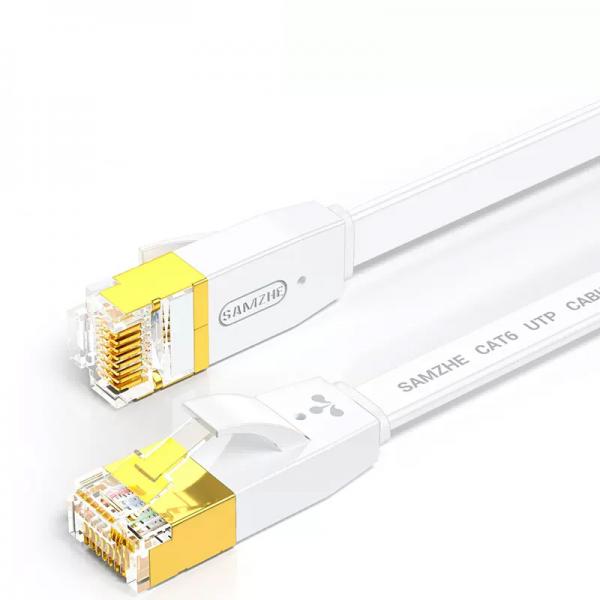
When discussing networking hardware, a common point of confusion arises between terms like "UTP patch cable" and "Ethernet cable." While these terms are often used interchangeably, they have specific meanings that are important to understand, especially when setting up or troubleshooting a network.
Understanding UTP Cables
UTP stands for Unshielded Twisted Pair, which is a type of cable that consists of pairs of wires twisted together to reduce interference from external sources. This twisting helps to minimize electromagnetic interference (EMI) and crosstalk between the pairs. UTP cables are commonly used in telecommunications and computer networking.
There are several categories of UTP cables, each designed for different levels of performance:
-
Cat5: Supports speeds up to 100 Mbps and frequencies up to 100 MHz. It was widely used in the past but is now largely replaced by higher categories.
-
Cat5e: An enhanced version of Cat5, it supports speeds up to 1 Gbps and frequencies up to 100 MHz. It is still commonly used in many networks today.
-
Cat6: Offers higher performance with speeds up to 10 Gbps over short distances and frequencies up to 250 MHz. It is suitable for more demanding network environments.
-
Cat6a: An augmented version of Cat6, it supports 10 Gbps speeds over longer distances and frequencies up to 500 MHz.
-
Cat7 and Cat8: These are designed for high-speed data centers and support even higher frequencies and speeds, with Cat8 supporting up to 40 Gbps.
Ethernet Cables Explained
Ethernet cables are a broad category of cables used to connect devices within a local area network (LAN). The term "Ethernet cable" doesn't refer to a specific type of cable but rather any cable that conforms to Ethernet networking standards. Ethernet cables can be made from various materials and come in different forms, including both UTP and shielded twisted pair (STP) cables.
Most commonly, when people refer to Ethernet cables, they are talking about UTP cables of various categories (Cat5e, Cat6, etc.), as these are the most widely used in residential and commercial networks.
Patch Cables
A patch cable is a specific type of Ethernet cable that is used to connect devices to a network. These cables are typically shorter and are used to connect computers to network switches, patch panels, or other networking equipment. Patch cables can be made from UTP, STP, or other types of cables, depending on the network requirements.
Are UTP Patch Cables the Same as Ethernet Cables?
In essence, a UTP patch cable is a type of Ethernet cable. However, not all Ethernet cables are UTP patch cables. The term "Ethernet cable" encompasses a broader range of cable types, including both UTP and STP cables, as well as different categories like Cat5e, Cat6, etc.
Choosing the Right Cable for Your Network
When selecting a cable for your network, it’s important to consider the following factors:
-
Network Speed Requirements: Determine the speed requirements of your network. For most home networks, Cat5e or Cat6 cables are sufficient. For more demanding applications, such as data centers or high-speed enterprise networks, Cat6a or higher may be necessary.
-
Distance: Consider the distance the cable needs to cover. While Cat5e and Cat6 can handle gigabit speeds over typical home distances, Cat6a and higher are better suited for longer runs and higher speeds.
-
Environment: If the cable will be used in an environment with a lot of potential interference (such as near electrical equipment), you might consider using STP cables instead of UTP to provide additional shielding.
-
Future-Proofing: If you anticipate needing higher speeds in the future, it might be worth investing in higher category cables now to avoid the need for replacements later.
-
Cost: Higher category cables typically cost more, so balance your budget with your performance needs.
Common Applications for UTP Patch Cables
UTP patch cables are used in various applications, including:
-
Connecting Computers to Switches: In both home and office networks, UTP patch cables are commonly used to connect computers to network switches or routers, facilitating network communication.
-
Patch Panels: In structured cabling systems, patch panels are used to organize and manage connections. UTP patch cables connect the ports on a patch panel to network switches, making it easier to manage and reconfigure network connections.
-
Telecommunications: UTP cables are also used in telephone networks, connecting phones to network jacks.
-
Audio/Visual Equipment: In some cases, UTP cables are used to connect audio/visual equipment, as they can transmit data over long distances without significant loss of quality.
Installation and Maintenance Tips
Proper installation and maintenance of UTP patch cables are crucial for ensuring optimal network performance:
-
Avoid Sharp Bends: Do not bend cables sharply, as this can damage the wires inside and degrade performance.
-
Maintain Proper Lengths: Use the shortest cable necessary to reduce the potential for interference and signal degradation.
-
Label Cables: In complex networks, label cables to keep track of connections and make troubleshooting easier.
-
Inspect Regularly: Periodically check cables for wear and tear, especially in high-traffic areas where they may be stepped on or otherwise damaged.
-
Use Quality Connectors: Ensure that the connectors (RJ45 plugs) are of good quality and properly attached to prevent connection issues.
Understanding the distinctions between UTP patch cables and Ethernet cables, and knowing how to select and maintain the right cables for your network, can greatly enhance the reliability and performance of your networking setup. Whether setting up a small home network or managing a large enterprise system, making informed choices about your cabling will pay dividends in terms of speed, reliability, and ease of maintenance.


